
STCrushers Is A Professional Minging Equipment Manufacturer since 2004, Providing High Quality Crushers, Sand Making Machines, Drying Equipment and more.
From Sand Dryer to Shipment: Planning for Bulk Loading, Bulk Bags, or 25 kg Bags
A customer orders 30 tonnes of dried sand per hour. If every tonne goes into 25 kg bags, the packing crew has to finish 1,200 bags an hour, or 20 bags a minute. If customers take 80% of the sand in bulk trucks and only 20% in small bags, the same dryer feeds a packing operation of just 240 bags an hour. Both figures assume that drying and packing run for the same hours.
That is where planning a sand drying and bagging line should begin: with the weight of finished sand going to each customer and the hours available to ship it. The dryer may run steadily while trucks arrive in batches and the packing crew works a shorter shift. A useful layout shows where the sand goes during those gaps.
Write the order in terms the customer could check on a delivery note: tonnes of saleable sand, at the agreed moisture and grade, in a specified package. A dryer quotation may give tonnes of wet sand entering the drum. Part of that weight leaves as water. If the dried sand is then screened into several grades, only the fraction sold in bags belongs in the calculation for that packing line.
For an illustrative 30 t/h of finished product with a 20% small-bag share, the calculation is 30 x 0.20 x 1,000 / 25 = 240 bags per hour. One detail can change that result before anyone chooses a machine: does 20% mean a little bagged sand every day, or one large bagged order every Friday? The weekly sales figures may be identical, but the Friday order needs either stock prepared in advance or more packing capacity that day.
Sales format | What sets the handling rate? | What to mark on the layout |
Loose sand in bulk trucks | Tonnes per truck, arrivals per shift and time available to load each vehicle | Storage outlet, loading position, vehicle clearance and route to weighing |
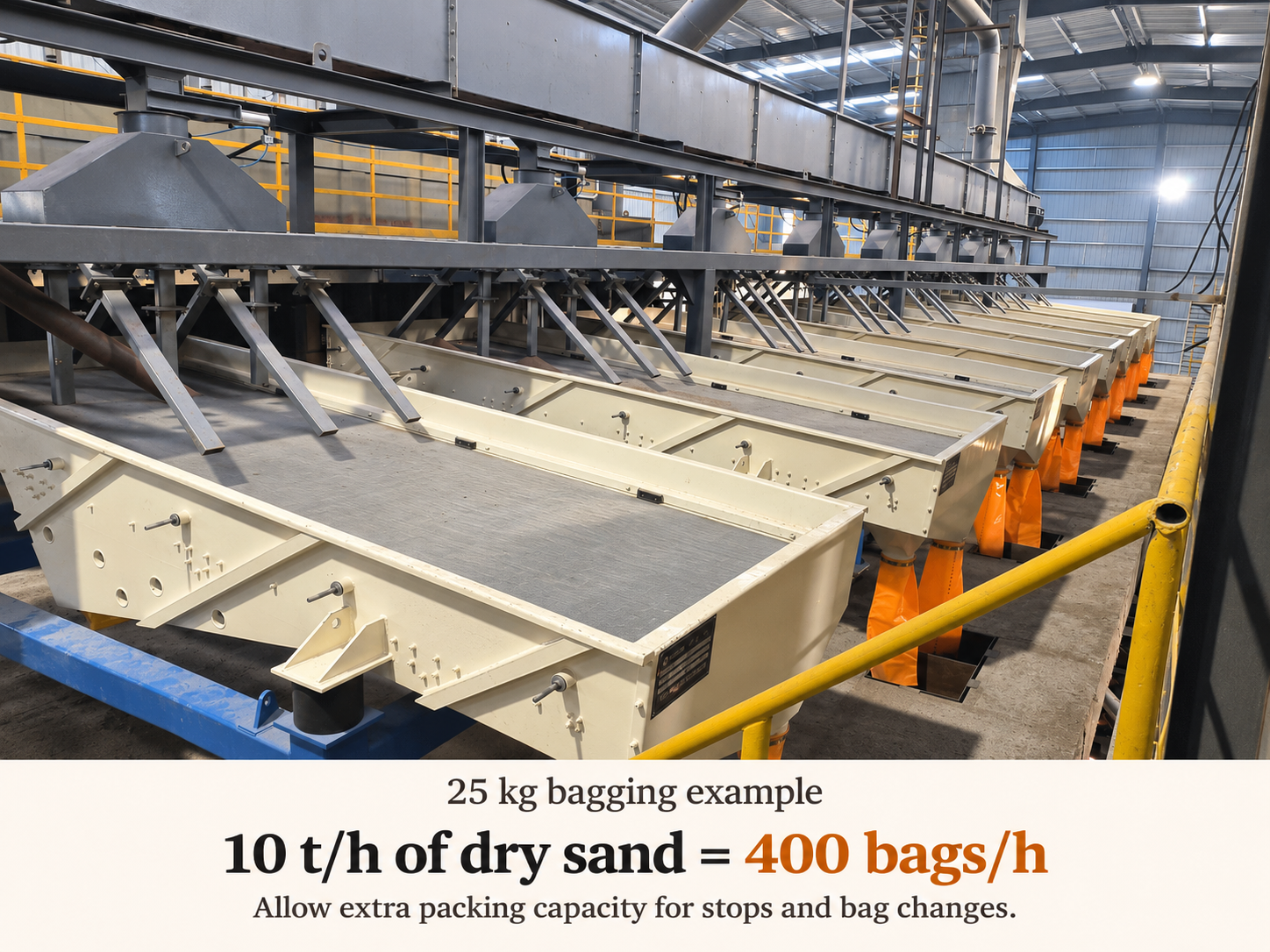
Bulk bags | Net weight per bag and the full cycle of fitting, filling, removing and replacing a bag | Space at the filling point, forklift access and a holding area for full bags |
25 kg bags | Filled and closed bags per working hour, including what the pallet station can accept | Packer inlet, closing station, pallet positions and a route for removing full pallets |
For truck sales, work back from the collection window. If a haulier wants 24 tonnes loaded in 20 minutes, the loading point must deliver an average of 72 t/h during those minutes. A 30 t/h dryer can serve that order if enough material has accumulated and the outlet and loading equipment can deliver it at the required rate. Buying a 72 t/h dryer would answer a different question.
For bag sales, watch what happens after the target weight is reached. With a bulk bag, the next fill may have to wait for a forklift. With small bags, a full pallet waiting to be removed can stop the closing station upstream. If you already operate a packer, count finished bags over a normal shift, including pallet changes. That figure is a better basis for planning than the fastest minute observed at the filling spout.
Return to the 20% bagged order. Suppose the dryer produces 30 t/h for 16 hours a day. The small-bag share is then 96 tonnes per day, or 3,840 bags. An eight-hour packing shift needs to average 480 finished bags per hour, double the 240 bags per hour calculated for equal shifts. If breaks and changeovers leave only six effective packing hours, the required running rate rises to 640 bags per hour.
A buffer bin can bridge the hours when the packing crew is absent. If the dryer runs for eight hours after packing stops and 6 t/h continues to go to the bagging bin, another 48 tonnes of bagging sand will accumulate during those eight hours. This is an inventory change, not a specified bin size. Check the starting stock, usable bin capacity and timing of withdrawals. If the crew can pack only 80 of the 96 tonnes produced each day, even a larger bin will eventually fill.
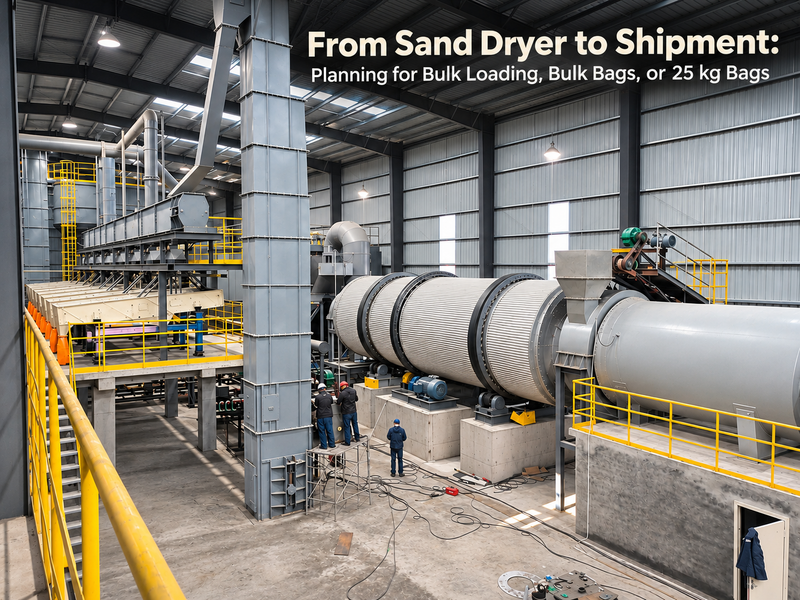
On the quotation drawing, trace the route from the three-cylinder sand dryer to one named handover point. "Discharge conveyor included" could mean the conveyor ends at floor level, while the inlet of your existing packing bin is several metres above it. Mark both elevations and identify who supplies the lift, connecting chute and supports. For a split route, show how the operator selects bulk loading or bagging and what happens when the receiving bin is full.
Also agree on the condition of the sand at that handover. Ask the packing supplier for the allowable product temperature for the selected bag and closure, and the dryer supplier for the expected sand temperature at the packer inlet under the proposed arrangement. Those answers determine whether cooling is needed. Confirm the finished moisture target separately: sand can meet the moisture specification and still be too warm for the selected package.
Give the supplier one representative day's order: finished tonnes by grade, share sold loose or bagged, net bag weights, dryer hours, packing hours and truck collection times. Include wet-feed tonnage and moisture as separate figures. If the project uses an existing packer, attach its inlet height, a layout or photograph, its measured shift output and the temperature limit provided by its supplier.
For a mixed sales order, ask for two acceptance figures in writing: tonnes of sand at the dryer handover and finished bags over the agreed packing period. Record who will measure each figure. This matters especially when the buyer owns the packing line: a trial at the drum outlet can confirm dryer output, but it cannot establish how many sealed bags reach the pallet.
Before accepting a dryer quotation, follow one tonne of finished sand to the point where your customer takes it. If the drawing ends before the truck, bulk bag or pallet, identify who supplies the missing connection. Send Sentai Machinery your sales split and existing layout so the dryer proposal can state where delivery ends and what the next piece of equipment must receive.
Related Articles: Sand Drying Plant Design: What Changes When the Final Moisture Target Is Strict; Should Wet Material Be Dewatered Before a Rotary Dryer?
Product Link: Three Cylinder Sand Dryer
 WhatsApp
 Email
 +86 15538010601