
STCrushers Is A Professional Minging Equipment Manufacturer since 2004, Providing High Quality Crushers, Sand Making Machines, Drying Equipment and more.
STCrushers Is A Professional Minging Equipment Manufacturer since 2004, Providing High Quality Crushers, Sand Making Machines, Drying Equipment and more.
A washing problem often becomes visible before the machine is selected. Mud coats the stone, screen apertures blind quickly, and the next process receives usable material mixed with clay. The first question is what kind of clay is attached to the feed and how easily it breaks down in water.
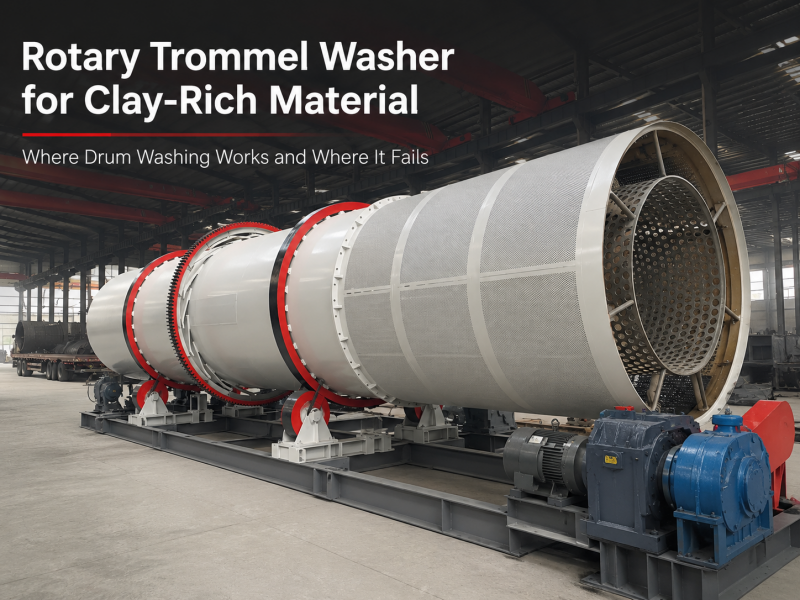
A rotary trommel washer can be effective for many clay-rich materials, but not every feed suits it. Its performance depends on contamination behavior, feed size, required cleanliness, available water, and the equipment following the drum. Treating all mud alike can produce poor cleaning despite normal machine operation.
Clay percentage alone does not define washing difficulty. Two feeds may both contain 15 percent mud and still require different processes.
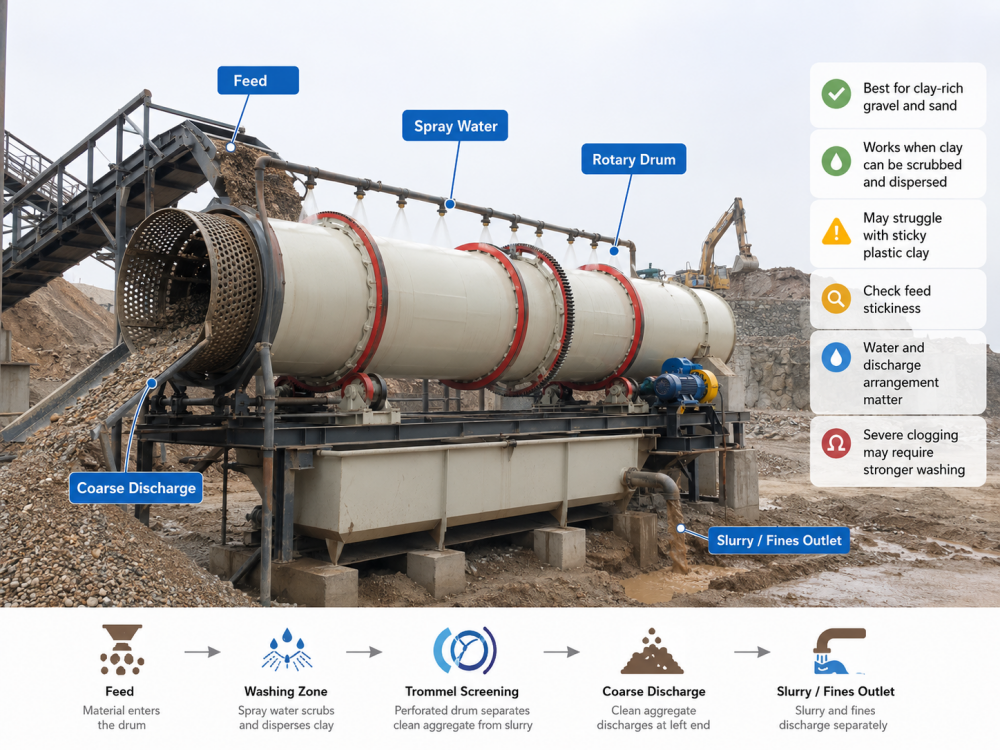
Loose soil, weathered fines, and light loamy clay often separate when material is lifted, dropped, rolled, and sprayed inside a rotating drum. Water softens the contamination, particles rub against each other, and loosened fines leave with the slurry.
Tough plastic clay behaves differently. It can smear, stretch, or form sticky balls instead of dispersing. In some cases, tumbling makes these balls larger. A rotary drum may then need help from a log washer, prescreening stage, stronger spray system, or another attrition process.
A basic material test is useful: place a representative sample in water, mix and rub it, then observe whether the clay dissolves, peels away, or remains as sticky lumps. For a large project, a controlled washing test is safer.
A rotary trommel washer is most suitable when the feed contains removable surface mud, light clay, soil, or soft contamination. It can be considered for gravel, alluvial material, weathered ore, aggregate, silica sand feed, and some gold washing circuits.
The drum accepts relatively coarse feed and provides more washing time than a simple rinse screen. Internal lifters raise and drop the material so water and particle contact loosen coatings. A screened discharge section can separate oversize from smaller washed material.
This arrangement is useful when the project needs to:
1. Receive coarse and uneven feed.
2. Break down loose mud and soft clay.
3. Rinse material continuously.
4. Make a rough size separation.
5. Prepare cleaner feed for crushing, screening, or gravity separation.
The equipment name should be clarified during quotation. A trommel screen mainly classifies by size. A rotary scrubber or trommel washer includes a washing and agitation duty. The quotation should state whether the machine includes a solid scrubbing section, perforated screening section, spray pipes, internal lifters, liners, and separate slurry discharge.
Material condition | Behavior in a rotating drum | Process implication |
Loose soil and light clay | Breaks down with tumbling and water | Rotary trommel washing is often suitable |
Surface coating on gravel or ore | Peels away through attrition | Check retention time and spray coverage |
High fines content | Cushions scrubbing and increases slurry volume | Consider prescreening or desliming |
Sticky plastic clay | Smears or forms clay balls | Consider log washing or stronger attrition |
Abrasive ore | Accelerates liner and screen wear | Plan wear protection and maintenance access |
Moisture, hardness, particle shape, and clay behavior can change the result.
A longer drum does not automatically provide better cleaning. Material must remain in the active washing zone long enough to soften, roll, rub, and release contamination.
Retention time is affected by drum slope, rotation speed, lifter arrangement, feed rate, water addition, and the depth of material in the drum. If overloaded, feed may move through as a dense bed with limited lifting action. If underfed, water and power use may be unnecessarily high.
Internal structures should match the material. Lifters increase lifting and dropping action, while discharge control can slow the flow when more washing time is needed. For abrasive applications, liner material and replacement access should be discussed before wear becomes a site problem.
An integrated trommel screen makes the line compact, but washing efficiency and screening accuracy are not identical design problems.
The washing section needs enough volume and agitation. The screening section needs suitable aperture size, open area, spray coverage, and discharge control. When the customer needs precise product sizes, a separate vibrating screen may classify more accurately after washing. When only rough separation is required, an integrated trommel section may be sufficient.
Final use changes the arrangement. A placer gold line may need oversize rejection before gravity concentration. An ore washing line may need clean lumps for crushing. An aggregate project may require several commercial sizes. A sand project may need fine recovery and dewatering rather than only coarse screening.
Every ton of clay removed becomes slurry that must leave the washer and enter a settling, thickening, or recycling system.
Insufficient water can leave clay attached to the product and create heavy slurry in the drum. Excessive uncontrolled water can increase pump load, settling area, and fine material loss. Water demand should be considered with clay content, feed rate, target cleanliness, and the use of recycled water.
The layout also needs space for slurry discharge, pumps, settling ponds or thickeners, dewatering equipment, and maintenance access. In a dry region, water recovery may decide whether the entire washing process is practical.
Before crushing, a rotary trommel washer can remove mud that would otherwise block feeders, coat crusher cavities, or reduce screening efficiency. After primary crushing, it may clean newly exposed surfaces before classification. In a gold gravity separation plant, it can reject clay and oversize before jigs, sluices, shaking tables, or centrifugal concentrators.
Position depends on where contamination causes the greatest problem. Washing too early may create unnecessary dirty water. Washing too late may allow clay to interfere with crushing, screening, or separation equipment.
A practical quotation should include more than capacity. Buyers should provide:
1. Material name and application.
2. Maximum feed size and size distribution.
3. Required hourly capacity.
4. Estimated clay, mud, and fines content.
5. Photos or videos of dry and wet material.
6. Whether the clay is loose, sticky, or plastic.
7. Required washed product size and cleanliness.
8. Available water supply and recycling plan.
9. Upstream and downstream equipment.
10. Site space, power supply, and operating hours.
A representative sample reduces guesswork when discussing washing difficulty, screen opening, water demand, and retention time.
A rotary trommel washer can simplify a clay-rich washing section when the contamination responds to tumbling, water, and material-on-material attrition. It can combine washing, rough screening, and coarse feed handling in one machine.
Its limit appears when the clay is too sticky, fines content is excessive, precise classification is required, or the slurry system is not prepared. In those cases, a larger drum may not solve the real process problem.
Sentai Machinery can review material, feed size, clay condition, capacity, water supply, and downstream process before recommending the configuration. Send a representative material description and the clean product condition so the washer, screen, water circuit, and discharge arrangement can be considered as one system.
1. Why Finished Sand Quality Depends on More Than the Sand Maker
2. Before Building a Sand Making Plant, Check These Site and Material Conditions
3. How to Choose Equipment for a Sand Making Plant
4. Gold Gravity Separation or Gold Flotation: Which Process Fits Your Ore Better
5. What Buyers Should Know Before Choosing Equipment for a Small Gold Ore Processing Plant
1. 100-150 tph Sand Making Plant
2. Gold Gravity Separation Plant
 WhatsApp
 Email
Email
 +86 15538010601