
STCrushers Is A Professional Minging Equipment Manufacturer since 2004, Providing High Quality Crushers, Sand Making Machines, Drying Equipment and more.
STCrushers Is A Professional Minging Equipment Manufacturer since 2004, Providing High Quality Crushers, Sand Making Machines, Drying Equipment and more.
In many mineral processing projects, buyers pay more attention to the ball mill and treat the spiral classifier as a simple matching accessory. This is a common mistake.
A spiral classifier does not only receive material from the ball mill. It controls which particles move forward to the next process and which coarse particles return to the mill for regrinding. This makes it an important control point in a closed grinding circuit.
If classification is unstable, the ball mill load may change, overflow fineness may fluctuate, downstream separation may become difficult, and recovery may be affected. A suitable classifier is not selected only by tank size or spiral diameter. It should be selected according to grinding target, ore characteristics, slurry condition, return sand load, and downstream process requirement.
For Sentai Machinery, spiral classifier selection should start from the required overflow quality, not from the machine size alone.
Overflow fineness is one of the most important indicators in classifier operation.
The overflow from the spiral classifier usually enters the next beneficiation stage, such as magnetic separation, flotation, gravity separation, or other mineral recovery processes. If the overflow is too coarse, useful minerals may not be fully liberated. This can reduce recovery or make concentrate grade unstable.
If the overflow is too fine, overgrinding may create excessive slime. Slime can affect magnetic separation, flotation foam behavior, reagent consumption, settling, filtration, and tailings handling.
The goal is not to make the overflow as fine as possible. The goal is to produce a stable particle size that matches the downstream process.
Before selecting the classifier, buyers should confirm the required grinding fineness and the process that follows the classifier. Iron ore magnetic separation, copper flotation, and gold gravity or flotation processes may need different particle size control.
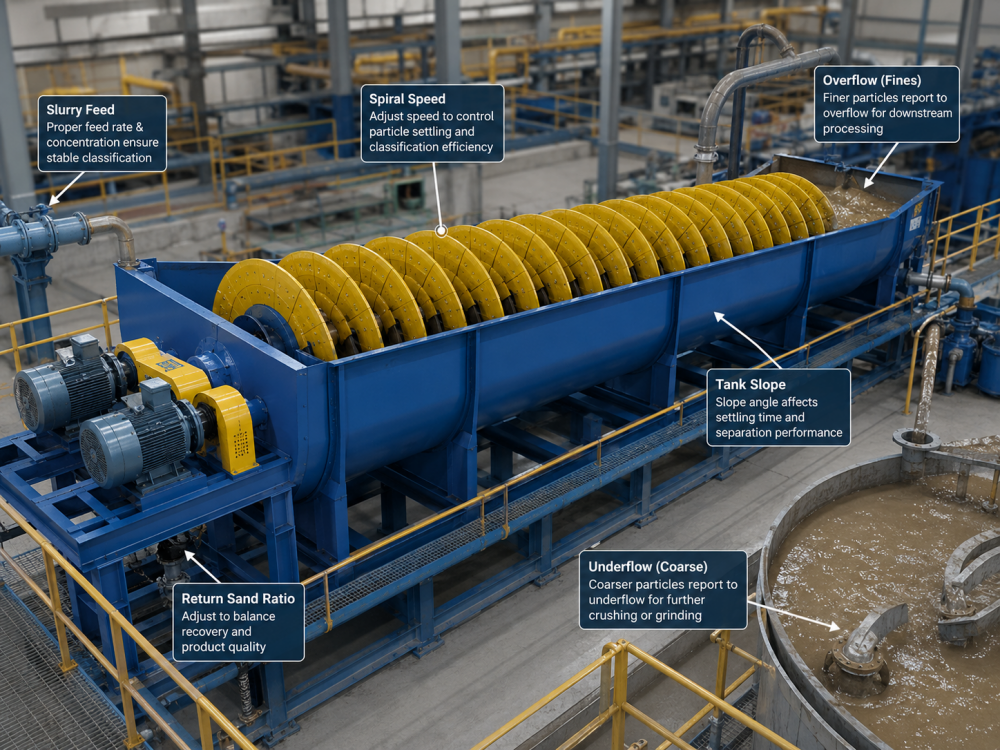
The spiral classifier separates coarse particles and sends them back to the ball mill as return sand. This return sand load has a direct effect on mill operation.
If the classifier sends too much material back to the ball mill, the mill load may increase. This can reduce practical output, increase power consumption, and make grinding less stable.
If too little coarse material returns to the mill, oversized particles may enter the next process. This can reduce separation performance.
A stable return sand ratio helps the ball mill work under a more predictable load. It also helps maintain a stable circulating load in the grinding circuit.
This is why classifier capacity should not be judged only by the overflow tonnage. The return sand handling ability is also important. The spiral diameter, trough length, spiral speed, slope, and lifting capacity should match the grinding circuit.
Classification depends on particle settling behavior. Slurry concentration can strongly affect this behavior.
If slurry is too thick, particles may not settle and separate clearly. Fine and coarse particles may mix, causing unstable overflow and return sand. If slurry is too dilute, the classifier may need to handle more water, and the separation effect may not match the process target.
Ore with clay or fine slime can make slurry behavior more difficult. High viscosity slurry may reduce classification efficiency and make the overflow less stable.
Before selecting a spiral classifier, buyers should consider:
1. Ore particle size after grinding
2. Slurry concentration
3. Clay or slime content
4. Required overflow fineness
5. Water supply condition
6. Downstream process sensitivity
A classifier that works well in one plant may not perform the same way in another plant if slurry condition is different.
Spiral speed and tank slope affect how coarse particles are lifted and discharged.
If the spiral speed is not suitable, the classifier may either return too much material or fail to lift coarse particles effectively. If the tank slope does not match the material and capacity, classification stability may be affected.
Coarser and heavier material may need stronger lifting ability. Finer material may need more careful settling control. The correct configuration depends on particle size, density, capacity, and water condition.
This is why a spiral classifier should not be selected only from a model table. The model table is a starting point. The real selection should consider how the classifier will work in the complete grinding and separation system.
Unstable classification can create several problems in a beneficiation plant.
The ball mill may face changing load. The overflow may become too coarse or too fine. The downstream magnetic separator, flotation machine, or gravity equipment may receive unstable feed. Tailings grade may fluctuate. Concentrate quality may become harder to control.
In some cases, operators may wrongly think the problem is caused by the separator or flotation machine, when the real issue starts from grinding and classification.
A stable spiral classifier helps the plant keep a more consistent particle size distribution. This makes downstream separation easier to control.
Scenario 1: Iron ore magnetic separation
Iron ore magnetic separation often needs stable grinding fineness before the magnetic separator. If the classifier overflow is too coarse, some iron minerals may not be properly liberated. If it is too fine, slime may affect separation and tailings handling.
Scenario 2: Copper or sulfide ore flotation
Flotation performance is sensitive to particle size and slime. The spiral classifier should help provide suitable overflow fineness for bubble-mineral contact and reagent action. Unstable classification can affect both recovery and concentrate grade.
Scenario 3: Small gold ore processing plant
In small gold ore plants, a ball mill and spiral classifier are often used together. If classification is unstable, gravity separation or flotation after grinding may not perform consistently. Stable overflow and return sand control can help reduce operation problems.
A common mistake is choosing the classifier only by spiral diameter.
Another mistake is treating the classifier as a fixed accessory of the ball mill. In fact, the classifier should match grinding fineness, ore density, slurry condition, return sand load, and downstream separation requirement.
Some buyers also ignore water condition. Without stable water supply and slurry control, the classifier may not produce stable overflow.
Another misjudgment is focusing only on capacity. A classifier that can process enough slurry may still be unsuitable if overflow fineness is not stable.
A useful discussion should start with the grinding and separation target.
First, provide ore type, feed size before grinding, and expected mill discharge size. Second, explain the required overflow fineness and downstream process. Third, confirm whether the next process is magnetic separation, flotation, gravity separation, or another recovery method.
Fourth, describe capacity, slurry concentration, water condition, and site layout. Fifth, discuss return sand handling and whether the classifier will work in a closed circuit with the ball mill.
With these details, the supplier can recommend a classifier configuration that supports the whole beneficiation process, not only a model that looks suitable on paper.
Spiral classifier selection should not begin with tank size alone.
Overflow fineness, return sand ratio, slurry concentration, spiral speed, tank slope, ore density, water condition, and downstream separation all affect the final selection.
For buyers, the better question is not only "What size spiral classifier do I need?" A more useful question is "What overflow fineness does my next process need, and what classifier configuration can keep it stable?"
When classification is stable, the ball mill works more smoothly and the downstream beneficiation process becomes easier to control.
If you are planning a grinding and classification system for iron ore, gold ore, copper ore, or other mineral processing projects, Sentai Machinery can help review your ore type, feed size, grinding fineness, slurry condition, return sand requirement, downstream process, and site layout.
Share your ore photos or videos, capacity target, required overflow fineness, and process route. Our team can help recommend a suitable spiral classifier and grinding circuit configuration based on your actual beneficiation conditions.
1. What Buyers Often Miss When Matching a Ball Mill and Spiral Classifier
2. Iron Ore Processing Plant Design: Confirm Ore Type Before Choosing the Process Route
3. Why Is Magnetic Separator Recovery Lower Than Expected
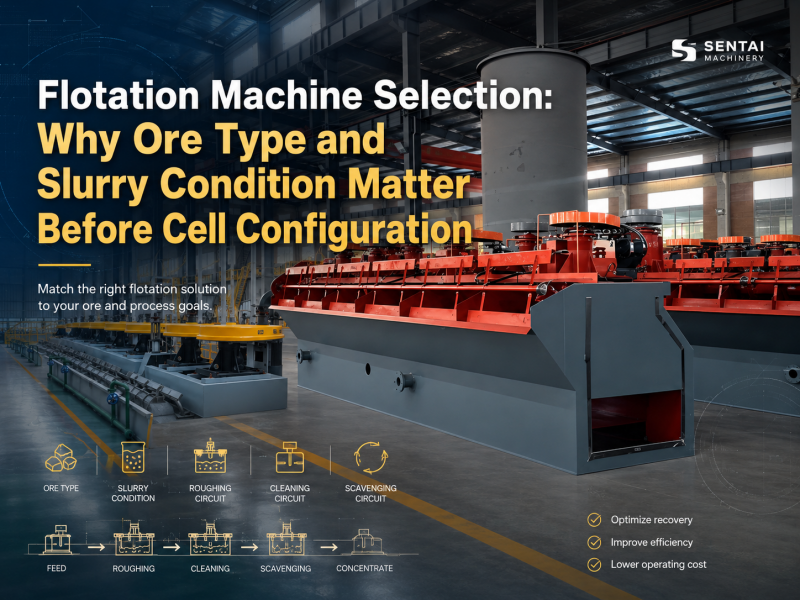
4. Flotation Machine Selection: Why Ore Type and Slurry Condition Matter Before Cell Configuration
5. Ball Mill vs Rod Mill: How to Choose the Right Grinding Stage for Mineral Processing
 WhatsApp
 Email
Email
 +86 15538010601