
STCrushers Is A Professional Minging Equipment Manufacturer since 2004, Providing High Quality Crushers, Sand Making Machines, Drying Equipment and more.
STCrushers Is A Professional Minging Equipment Manufacturer since 2004, Providing High Quality Crushers, Sand Making Machines, Drying Equipment and more.
The first layout drawing may carry a 50 TPH label even though the owner hopes to reach 100 TPH as demand grows. That ambition sounds straightforward: operate a smaller plant now, then add a larger machine when orders justify the investment. In practice, the machine is rarely the hardest part. Material routes, foundations, power distribution, stockpiles, roads, and maintenance access may already have fixed what the site can become.
A practical stone crusher plant expansion plan therefore protects the decisions that are expensive to reverse, delays equipment that does not yet create value, and rechecks assumptions that may change before Phase 2 begins. Leaving unused land beside a crusher is helpful, but it is not an expansion strategy by itself.
A future capacity figure needs a product definition. Doubling fresh feed is different from doubling qualified 20-40 mm aggregate, adding two smaller screen cuts, or diverting material into manufactured sand. Each target shifts load to a different point in the circuit. More fine products may demand additional screening area and conveyors even when the primary crusher still has mechanical margin. A tighter top size can increase the duty of the secondary stage and the return loop.
The existing 50 TPH versus 100 TPH comparison shows why higher output changes feeding, internal movement, screening, storage, and power together. For expansion planning, the lesson is more specific: define the future saleable products before deciding what Phase 1 must preserve.
Every Phase 1 decision can be placed into one of three groups. The classification prevents two opposite mistakes: building a compact layout that cannot grow, or spending heavily on idle capacity that may never be used.
Decision area | Phase 1 treatment | Reasoning |
Land, elevations, conveyor corridors, stockpile zones | Reserve now | Later changes can disturb civil work, traffic, drainage, and the operating line. |
Extra crusher, screen, conveyors, and auxiliary modules | Install later | Equipment should enter the project when defined demand and process duty justify it. |
Electrical room space, cable routes, connection points | Reserve interfaces now | The future load still requires a project-specific electrical review before Phase 2. |
Feed properties, product mix, return load, working hours | Revalidate later | Actual operating data may challenge the assumptions used in the original expansion concept. |
A new crusher can arrive on a truck. Changing the elevation of the existing screen, moving a return conveyor through an occupied corridor, or creating another product route can interrupt the running plant and trigger civil rework. The first plant layout should identify where future feed, oversize, finished aggregate, and any sand-making branch could travel. It should also protect transfer heights and discharge directions, because a free patch of ground is of little use if material cannot reach it cleanly.
Expansion studies often begin with the secondary crusher because it appears to set production. The first restriction may instead be the hopper loading cycle, feeder width, primary crusher opening, screen area, return conveyor, or product conveyor. A machine with unused nameplate capacity cannot remove a bottleneck upstream or downstream. The review should trace both fresh feed and circulating material through every shared component, then identify which equipment can remain, which needs modification, and which requires a parallel route.
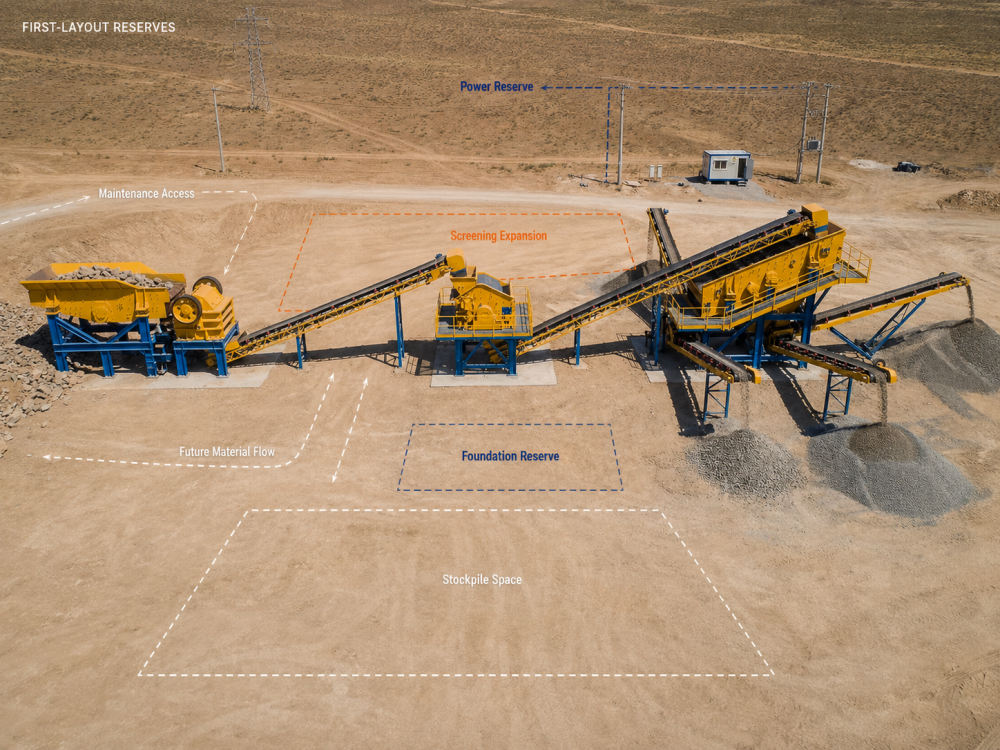
Some owners consider pouring every possible foundation during Phase 1. That approach can be premature when the future model, loads, or process elevation remain uncertain. A better objective is to protect the location, geotechnical assumptions, access, and tie-in points needed for later work. The guidance on foundation preparation remains relevant: final dimensions, reinforcement, anchor details, and structural design must follow confirmed equipment loads and local engineering requirements. Reserving an interface is different from guessing a final foundation years in advance.
The electrical concept should show whether future motors can be connected without relocating the control room or rebuilding the main cable route. Space for additional motor control, practical connection points, earthing provisions, and transformer or generator strategy may deserve early attention. However, the article on stone crusher plant power requirements explains why connected kilowatts alone are not enough. Phase 2 still needs a revised motor schedule, operating sequence, starting-demand review, cable assessment, and final design by qualified local electrical professionals.
A larger process can fail commercially if the site cannot handle its products. More output may require wider separation between aggregate piles, additional product conveyors, faster loading, or different truck circulation. Future machinery also needs crane access and space to remove wear parts without dismantling neighboring equipment. These apparently secondary areas should be tested on the first layout because buildings, workshops, drainage channels, and permanent roads can close them long before expansion starts.
Buying the largest feeder, crusher, screen, transformer, and conveyor at the beginning can lock capital into capacity that current sales do not use. It may also create poor balance if one oversized machine feeds smaller downstream equipment intermittently. Published 40-60 TPH and 80-100 TPH solution pages illustrate that higher capacity normally changes several connected components. They are reference configurations, not proof that one standard plant can be upgraded by replacing a single machine.
Integrating Phase 2 into the first circuit is attractive when important equipment can be shared and the tie-in work is controlled. A separate line may be better when the new feed is different, the product plan has changed, independent operation matters, or modification would require a long production shutdown. Parallel lines can also preserve the original plant as a smaller flexible unit. The comparison should include tie-in downtime, duplicate support equipment, operating flexibility, site movement, and the remaining life of Phase 1 assets rather than judging only the new machine price.
The phrase 'expand later' becomes useful only when later has a trigger. That trigger might be sustained order volume, longer operating hours, repeated inability to build stock before dispatch, or measured load at a shared screen or return circuit. Phase 1 should also create the data needed for the next decision: actual feed grading, rock behavior, wear, product yield, return flow, motor load, downtime, and sales mix. Expansion based on this evidence can differ from the option imagined before production began.
An expandable stone crushing plant is not a small line surrounded by empty ground. It is a first-stage system whose difficult interfaces remain open while unnecessary equipment waits for a proven need. Protect material routes, access, civil boundaries, and electrical options now. Purchase later modules when their duty is defined. Revalidate the original assumptions with operating and market data before Phase 2. If those three disciplines cannot be maintained, planning an independent future line may be the more reliable route.
Share the current and future capacity targets, raw material, maximum feed size, required product sizes and proportions, site drawing, power supply, operating schedule, and expected expansion stage. Sentai Machinery can map which parts of the proposed stone crusher plant should be reserved now, installed later, or revalidated before the next investment. Final civil and electrical work should be confirmed against local site conditions and engineering requirements.
50 TPH vs 100 TPH Stone Crusher Plant: What Changes in Equipment, Site, Power, and Budget
How Much Does a Stone Crusher Plant Cost? Build the Budget From Equipment Quote to First Production
How Long Does It Take to Build a Stone Crusher Plant? From Design Confirmation to Trial Production
What Site Information Should Buyers Provide Before Plant Layout Design
40-60 TPH Stone Crushing Plant
80-100 TPH Stone Crusher Plant
 WhatsApp
 Email
Email
 +86 15538010601